
We vote in accordance with what we believe is in the best interests of HOOPP and our members, which may result in our votes differing from management’s recommendation. Our duty is to exercise our voting rights in a manner that supports sustainable, long-term value creation. You can learn more about how we vote in our Proxy Guidelines (opens in new tab).
In 2025, HOOPP voted on over 8,800 proposals at shareholder meetings. Consistent with prior years, more than two-thirds of all proposals related to board director elections. Electing qualified and effective directors is important, as boards are responsible for overseeing management and guiding a company’s strategic direction. HOOPP may withhold support for director candidates if there are concerns related to governance practices, oversight, accountability or long-term alignment. We voted against management on approximately 13% of proposals.
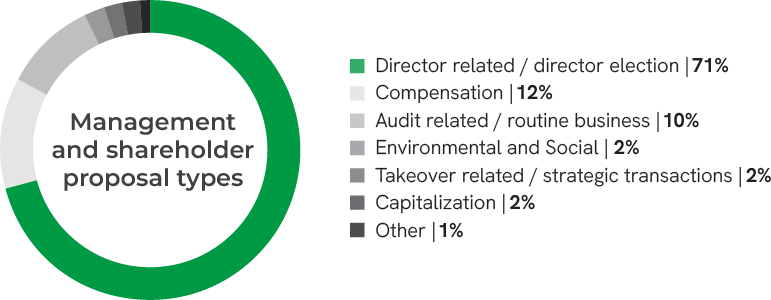
Approximately 12% of proposals related to executive compensation (often referred to as “say-on-pay” votes), which allow shareholders to express a view on whether executive pay appropriately reflects company performance. In 2025, we voted against management on executive compensation proposals 23% of the time. When reviewing these proposals, we assess whether pay outcomes and incentive structures are aligned with long-term value creation and appropriate performance metrics.
We supported 32% of environmental and social shareholder proposals and 32% of climate-related shareholder proposals. Support percentages for environmental and social proposals exclude shareholder proposals that seek to limit or reverse companies’ existing sustainability-related practices. When reviewing shareholder proposals, we consider factors such as materiality, whether a proposal is overly prescriptive, the company’s existing practices and disclosures, and market-specific considerations.
The number of shareholder proposals declined compared to prior years, reflecting market-specific and regulatory developments.
We periodically review and update our Proxy Voting Guidelines to reflect evolving market practices and governance expectations. Updates made in 2025 are reflected in the current version of our guidelines.