



Meet Claire
See how her lifetime pension and bridge benefit would change if she worked full time vs. part time. You’ll see that her total pension payments will exceed the amount she contributed during her career.
The lifetime pension you receive in retirement is calculated using a formula that’s based on your earnings and how much service you have built in the Plan.
The more service you build and the higher your earnings, the greater your pension will be.
On this page, you’ll find details about how your pension is calculated, information about how it works for part-time employment and interactive examples to help you explore how your pension might change in different scenarios.
Your pension is calculated using your average annualized earnings from your best five consecutive years in the Plan, your years of contributory service and the average year’s maximum pensionable earnings (YMPE).
For each year of contributory service, you will receive:
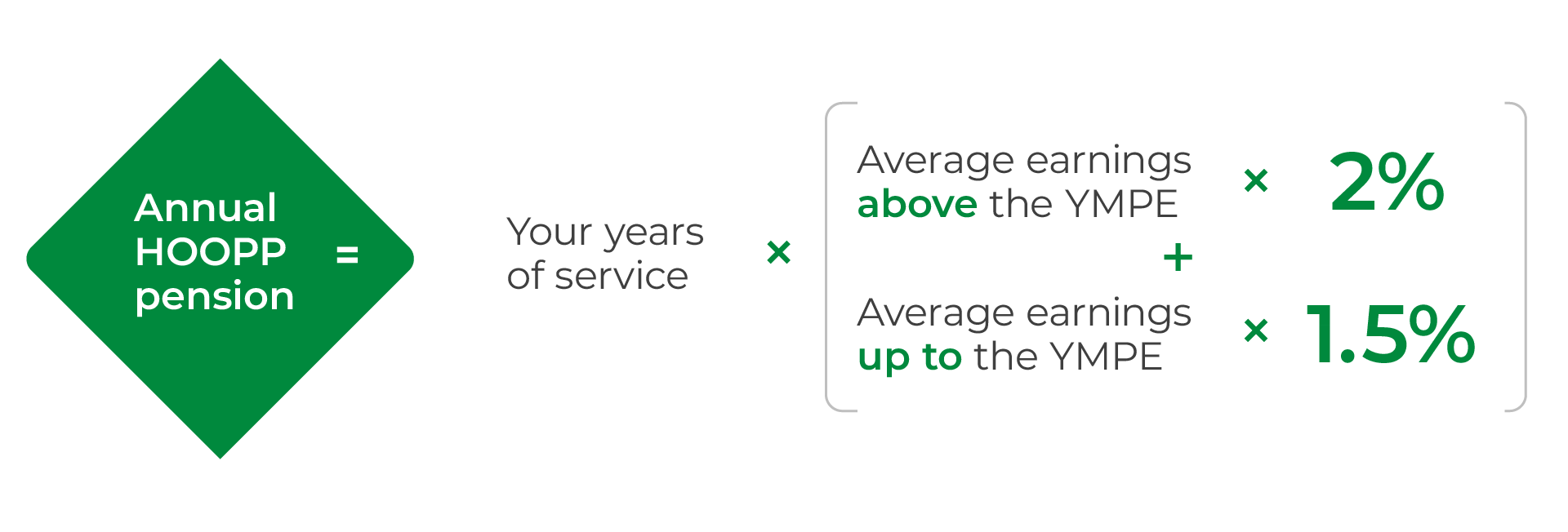
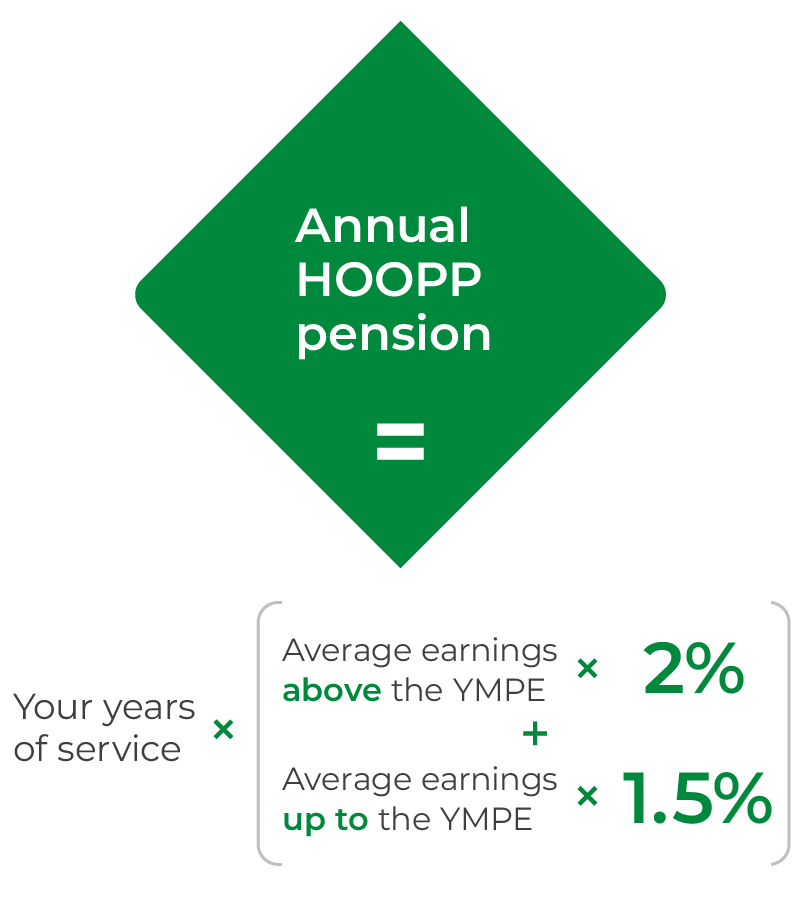
1.5% of your average annualized earnings up to the average YMPE
2% of your average annualized earnings above the average YMPE
Your lifetime pension is calculated using the formula below. We also apply any adjustment if you decide to retire early or later.
YMPE stands for year’s maximum pensionable earnings. It’s an amount set each year by the Canadian government based on the average wage in Canada. At HOOPP, the pension formula applies a different rate up to and above your average YMPE when calculating your pension. It uses the average of the YMPE from the five years before your HOOPP pension is calculated.
In 2026, the YMPE is $74,600.
If you work part time, we annualize your earnings to calculate your pension. That means we use the amount that you would have earned working full-time in your position when we determine your best five consecutive years of earnings.
See how her lifetime pension and bridge benefit would change if she worked full time vs. part time. You’ll see that her total pension payments will exceed the amount she contributed during her career.
Put yourself in Diane's shoes and explore the example below to see how her pension can change depending on:
her age when she joined HOOPP
if she worked full-time or part-time hours
her average annualized earnings, measured over her best five consecutive years
Try out different scenarios and see for yourself how the pension formula works.
Keep in mind: This example assumes that a member retires at age 65. However, members may retire at an earlier age with no reduction to their lifetime pension. Learn more about early retirement benefits.
Get a personalized estimate of your future pension and see what it could look like at different ages and salaries.
You can start your pension as early as age 55 or as late as age 71. Generally, the later you retire, the higher your pension will be. If you retire before either age 60 or 30 years of eligibility service, your pension will be adjusted lower because you will likely receive it for longer. Once you reach one of those milestones, you can start your pension anytime without the early retirement adjustment or continue working and building your pension until you are ready to retire.
If you retire before age 65, you will also get a monthly bridge benefit on top of your monthly pension. This is paid until age 65 (or you pass away) and does not change if you start your Canada Pension Plan (CPP) payments early.
Find out more about choosing a retirement date, how retiring early affects your pension and how the bridge benefit works.
HOOPP has periodically approved benefit improvements for eligible active members. These enhancements build on each other to help provide even more security in retirement. Find out how benefit improvements work and try our interactive scenario.