

Cora is a 60-year old Nurse from St. Catharines, ON. She’s decided it’s time to retire and is eager to start this new chapter in her life. As she is about to start her HOOPP pension, she wonders which spousal benefit option will make sense for her and her spouse. She knows her HOOPP pension will be a significant part of their total household income in retirement and is an important part of the “big picture” for her to consider. Cora also has other considerations to keep in mind:
Cora’s spouse, Ron, is 62 years old and already retired.
Cora and Ron are both in good health and live comfortably but modestly. They are fortunate enough to own their house and have no mortgage. Their children are grown and already live on their own independently.
Ron does not have a workplace pension but has been prudent about saving for retirement. He has started to withdraw money from his personal savings in a registered retirement income fund (RRIF).
Both Cora and Ron plan to start receiving their Canada Pension Plan (CPP) and Old Age Security (OAS) at age 65.
Cora also wonders about Ron’s future financial well-being if she were to pass away first. What would that look like?
Cora has three spousal benefit options to choose from at the time of her retirement: 66 2/3% of her monthly pension, or she can increase this benefit to 80% or 100%. The benefit option she chooses will represent the percentage of her monthly pension that will be paid to Ron as a spousal pension if Cora passes away in retirement. Selecting an increased spousal benefit option will result in Cora's pension being slightly lower, but will provide Ron with additional financial security in the event she passes away first. With all these things in mind, Cora considered which of the spousal benefit options below would be right for her personal circumstances:
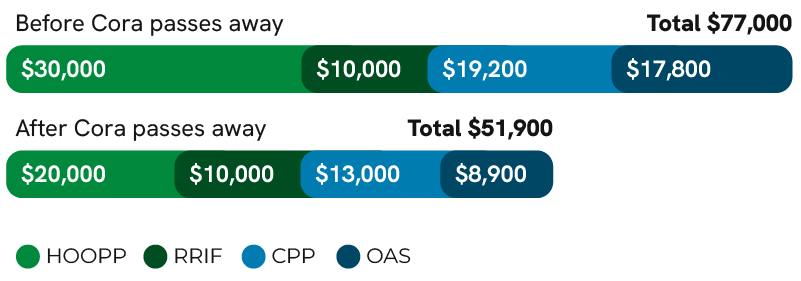
Choosing the 66 2/3% spousal benefit option will provide Cora and Ron with a total household income of $77,000/year ($48,500 from Cora and $28,500 from Ron) at age 65, when Cora’s CPP starts.
This option will give them the largest amount of annual household income in retirement of the three options.
Although Cora’s CPP and OAS pensions will stop, Ron will receive a CPP survivor’s pension in addition to his own CPP and OAS pensions.
Ron will also continue to rely on the $10,000 annual income ($833 monthly) he receives from his RRIF.
With all these sources of income, Ron’s total household income will be $51,900/year, before taxes, after Cora passes away.
This option will provide Ron with 67%, before taxes, of their previous total household income.
Spousal benefit option
Cora's annual pension
Ron's annual survivor pension
66 2/3%
$30,000
$20,000
80%
$29,600
$23,700
100%
$28,700
$28,700
Note: Income replacement ratios compare your spouse’s household income levels before and after your passing. For example, a 67% income replacement ratio indicates that Ron’s household income after Cora passes away could be about 67% of what it was before Cora’s passing.
Cora was developed as an example by HOOPP for illustrative purposes only. This example assumes that Cora retires at age 60 and starts her CPP and OAS at age 65. It also assumes that she passes away before age 75 (the age when OAS increases). All amounts are before taxes and do not include any future cost-of-living adjustments on her HOOPP pension, or any increases to CPP or OAS benefits. Cora and Ron start receiving their CPP and OAS at age 65. They both receive the average amount of CPP and the maximum OAS benefits payable on January 1, 2026. After Cora passes away, Ron continues to receive his CPP pension, plus the CPP survivor’s pension. The CPP survivor benefit calculation is complex and may be impacted by the amount of retirement pension that you or your spouse receive. In this example, the survivor pension is assumed to be 36% of the average amount of CPP pension payable to someone retiring on January 1, at age 65 and this combined amount is below the maximum CPP that applies in this situation. Life insurance or other assets were not included in the example.