

People often ask whether Canadians are saving enough for retirement. But having enough money to live on through your senior years is about more than just saving. It involves:
making the right investment decisions,
having investment discipline during the market’s ups and downs, and
managing risk over the long term to ensure that you don’t outlive your money.
With all these considerations, the questions we should be asking are:
What is the most efficient way for Canadians to save for retirement?
What can be done to help reduce the cost of retirement for more Canadians?
HOOPP commissioned Common Wealth to lead research to answer these questions, with support from Ryerson University’s National Institute on Aging.
The Value of a Good Pension identifies five value drivers that combine to drastically reduce the cost of retirement.
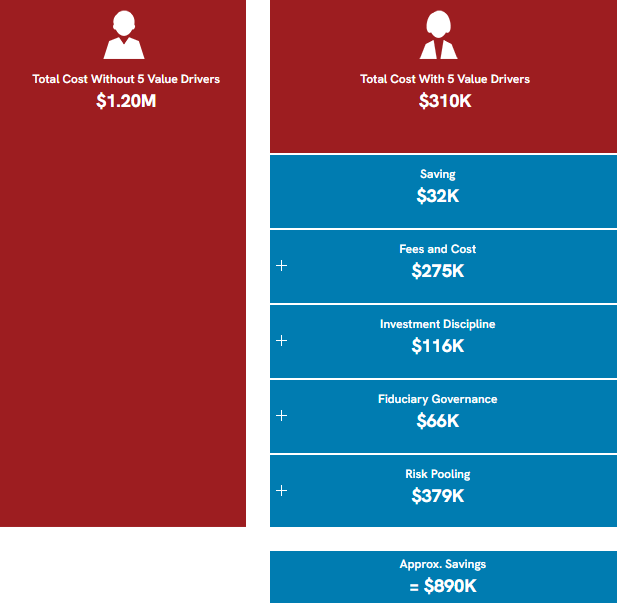
When all five value drivers are used efficiently, the cost of retirement can be reduced by as much as $890,000.
Let’s take a closer look:
Saving
In a purely voluntary system (do-it-yourself approach), people tend to save less, save later, and save less consistently than under a collective plan with mandatory contributions or automatic enrolment.
Fees and costs
The costs of investment management and administration can have a significant impact on the growth of retirement investments. The costs for good pension plans tend to be significantly lower than the costs of retail investing and advice.
Investment discipline
When investment decisions (e.g., asset allocation, security selection, market timing) are made by professionals, they tend to produce better results than when these decisions are made by individuals who “have a striking ability to do the wrong thing."*
* Andrea Frazzini and Owen Lamont, “Dumb Money: Mutual Fund Flows and the Cross-Section of Stock Returns” (2008)
Fiduciary governance
When investments are managed on a non-profit basis by in-house professionals with a fiduciary responsibility to members, they tend to perform better than retail funds offered by for-profit organizations.
Risk pooling
Most individual investors must manage their longevity and investment risk on their own, adopting costly strategies (e.g., larger nest egg, smaller draw down, highly conservative post-retirement asset allocation) to avoid outliving their money. By contrast, a good collective retirement plan can create efficiencies by pooling longevity and investment risk.
It costs the average worker saving for retirement on their own $1.2 million in lifetime savings to achieve a 70% replacement rate in their retirement income, while those that leverage the 5 value drivers need to save only $310,000 to achieve the retirement income. See how the value drivers combine to reduce the cost of retirement by $890,000.
Canada-model pensions leverage all five key value drivers and thereby deliver significant benefits to individual savers and the broader economy:
Canada-model pension members have more money in their pockets to spend during their working years.
They also spend more in retirement without fear of outliving their savings in retirement.
But more needs to be done for those without such arrangements. In this era of tight household budgets, low growth and government austerity, we need to improve the efficiency of retirement savings for all Canadians. Failure to do this will be costly for individual savers, taxpayers, the government and the economy in the long run.
So what can we do about it?
We hope that this research supports policy makers and other stakeholders to explore how these five value drivers can be used to everyone’s benefit. In the immediate future, public policy and regulations can help improve conditions by:
Enhancing scale and portability
Making savings automatic
Encouraging good governance and fiduciary standards
Introducing more risk pooling in the decumulations phase of capital accumulation plans.